
Content Creation Agency: Strategy, Video Production & Brand Design
Two agencies can show equally polished portfolios and deliver very different results. The difference often appears after the contract is signed—when briefs, revisions, ownership, and reporting become real.
What Does a Content Creation Agency Do?
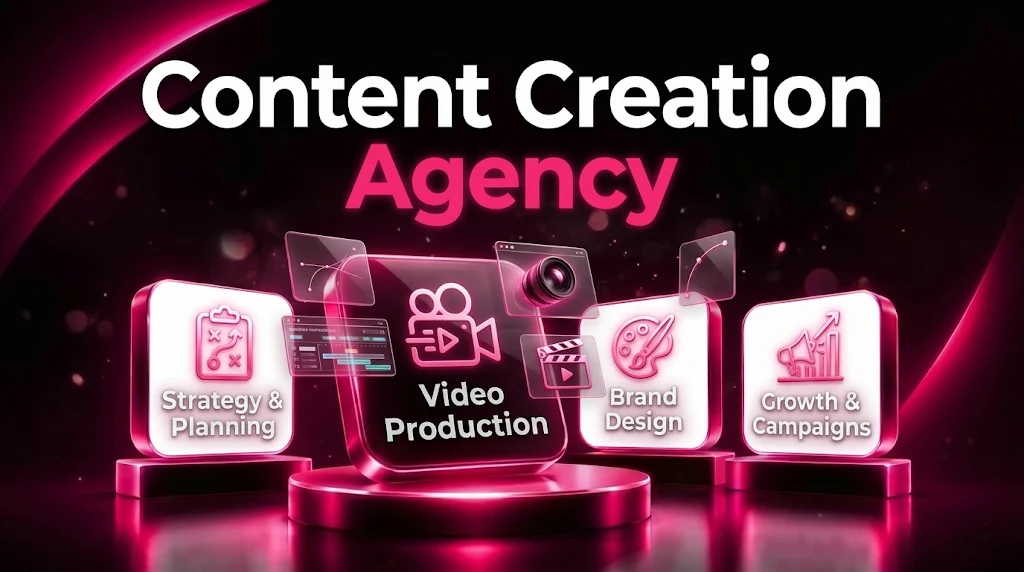
A content creation agency develops communication assets for a business, often combining strategy, copy, design, photography, video, and editing. An agency may also offer content calendars or campaign concepts. Publishing, community management, paid advertising, and influencer coordination are separate responsibilities unless explicitly included.
The right partner is not necessarily the agency with the largest portfolio. It is the one whose skills, process, and capacity fit your business problem.
9 Questions to Ask a Content Creation Agency
1. Who is the content for?
Ask the agency to describe your audience in practical terms: customer needs, objections, decision triggers, and preferred channels. Generic answers such as “everyone online” suggest insufficient research.
2. What business outcome will the content support?
Awareness content, product education, lead generation, and retention require different creative approaches. Agree on a primary objective for the project before discussing the number of posts.
3. Can you show relevant work and explain the thinking behind it?
Look for examples with similar audiences, formats, and complexity. Ask what the client brief required and what constraints shaped the creative work. A portfolio is useful evidence of production quality, but it does not automatically establish business impact.
4. Who will actually create the assets?
Clarify whether strategists, designers, editors, photographers, and specialists are in-house or external partners. Either model can work; what matters is accountability, quality control, and capacity.
5. What is included in the price?
Request an itemized list covering concepts, scripts, number of graphics or videos, revisions, subtitles, format variations, shoot days, props, talent, and travel. Separate ongoing management fees from production costs and ad spend.
6. Who owns the final files and usage rights?
Confirm who can use the final content, which source files are delivered, whether licensed music or stock images carry restrictions, and how long usage permissions last. Intellectual-property rules and contract terms differ across jurisdictions.
7. How are feedback and approvals handled?
Ask for an example workflow. Define the reviewer, revision rounds, sign-off criteria, and a single place to track feedback. Without a process, small changes can repeatedly delay a campaign.
8. How will content be adapted for each platform and market?
A vertical video made for short-form platforms is different from a website hero or a LinkedIn carousel. If you target US buyers and other markets, ask how the agency will adapt language, cultural context, and formats rather than simply duplicating assets.
9. What will you report after launch?
Agree on practical measures such as qualified leads, product inquiries, click-through behavior, useful engagement, and conversions. Creative assets cannot be held responsible for every business result, so measurement must also account for landing pages, pricing, audience targeting, and sales follow-up.
A Simple Agency Comparison Scorecard
| Factor | What good looks like | Warning sign |
|---|---|---|
| Strategy | Clear audience, objective, and message | Only talks about posting volume |
| Work quality | Relevant portfolio and rationale | Unexplained, generic examples |
| Scope | Written deliverables and revisions | Vague “unlimited content” promise |
| Ownership | Documented file and license terms | Unclear usage rights |
| Reporting | Metrics tied to the agreed goal | Promises guaranteed virality |
Should You Hire an Agency, Freelancer, or Internal Team?
A freelancer can be efficient for a clearly defined skill such as motion graphics or editing. An internal team can provide close access to brand knowledge and faster day-to-day coordination. A content creation agency can be useful when strategy and several production disciplines must work together.
A hybrid arrangement is also valid: an internal marketer owns messaging and approvals, while an external creative partner handles planned production. Choose based on workload, oversight capacity, and the complexity of deliverables—not the label alone.
What to Include in Your First Creative Brief
Provide your business overview, audience, offer, brand examples, priority channels, key message, required formats, deadlines, review owner, and budget boundaries. Share existing brand guidelines and examples of content you do and do not like, with a short explanation of why.
Before agreeing to a retainer, consider testing a limited project. For example, commission one campaign concept with a short video, two static variations, and a defined approval process. A pilot can reveal collaboration quality without assuming it guarantees future results.
Current Content Trends Are Not a Substitute for Fit
HubSpot’s 2026 marketing research highlights ongoing interest in visual and short-form content. That makes platform-native creative worth evaluating, but a trend report cannot determine your ideal channel or production budget on its own.
Working with The Virtual Minds
The Virtual Minds Content & Culture covers creative storytelling, social media visuals, and video content. Businesses needing product photography, commercial visuals, or video production can review Creative Shoots & Production. Discuss the scope, production approach, and deliverables before committing to a project.
Frequently Asked Questions
How do I know if a content creation agency is good?
Look for relevant examples, clear briefs, consistent production quality, transparent ownership terms, and a process for evaluating performance. No single metric proves quality.
Can an agency guarantee views or sales?
No responsible agency can guarantee platform distribution or commercial outcomes. Ask for measurable goals and realistic assumptions instead.
Should I choose a local or international content agency?
Choose based on production needs, communication, market understanding, and workflow. Location matters more for on-site shoots and less for digital-first design or editing work.
Discuss Your Content Brief
Have an upcoming campaign? Contact The Virtual Minds with your audience, deliverables, and timing to explore an appropriate production plan.
