
Brand Strategy Services: 7 Steps to Build a Stronger Brand
Your logo looks polished. So why do customers still struggle to explain what makes your business different? Design can make a brand recognizable, but it cannot replace a clear reason to choose it. That’s where brand strategy services come in.
Brand strategy defines the audience, position, promise, personality, and messages that guide how a business presents itself. For small companies in the United States and brands serving international markets, this foundation can keep website copy, sales conversations, and marketing campaigns aligned.
What Do Brand Strategy Services Include?
Depending on the project, brand strategy services may cover audience research, competitor reviews, value proposition development, brand positioning, messaging, voice and tone, identity direction, and implementation guidelines. A brand strategy should connect business objectives with what real customers value—not just produce a list of attractive adjectives.
NielsenIQ describes brand strategy as a longer-term plan for developing and maintaining a brand’s position. Marketing campaigns then operate within that broader direction.
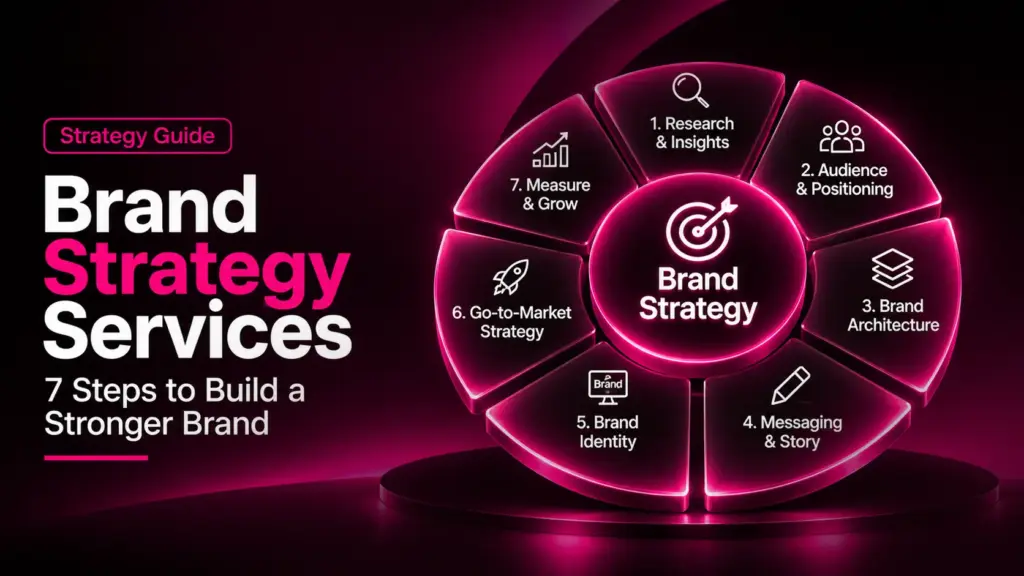
7 Steps in a Practical Brand Strategy Process
1. Define the Business Goal
Start with the decision the strategy needs to support. Are you entering a new market, attracting higher-value buyers, improving recognition, or bringing several services under one clear promise? A specific goal helps keep the research relevant.
2. Identify Your Most Valuable Audience
Describe buyers using more than basic demographics. Explore their challenges, expectations, alternatives, and reasons for choosing one provider over another. US customers may prioritize different buying criteria from customers in the UK, Canada, or Australia; test assumptions instead of simply changing the country name in your messaging.
3. Examine Competing Brands
Review how direct competitors describe their offers, which promises they emphasize, and where customers still experience confusion or frustration. Look for a real, defensible difference rather than copying a popular slogan.
4. Write Your Brand Positioning
A positioning statement can follow this working structure: “For [audience], [brand] provides [benefit] through [distinct approach], unlike [alternative].” It is an internal decision tool, not necessarily the headline you publish on your homepage.
For example, a fictional accounting firm might position itself around transparent monthly reporting for growing online retailers rather than generic “world-class financial solutions.” Good positioning makes the intended audience and value clear.
5. Define Your Brand Promise and Personality
Choose a promise your company can actually deliver, then define how you will communicate it. “Clear, practical, and responsive” is useful only when customer service, onboarding, and deliverables reflect those qualities.
6. Develop a Consistent Messaging System
Build a core message, supporting proof points, tone of voice, and key talking points for different customer questions. Your website, proposals, email campaigns, and social media should sound like the same business even when the format changes.
7. Apply the Strategy and Review It
Translate the strategy into website content, identity guidelines, sales materials, and campaign briefs. Then gather customer feedback, monitor lead quality and sales conversations, and refine what isn’t clear. Strategy is useful when it changes decisions—not when it sits in an unused presentation.
Brand Strategy vs. Brand Identity vs. Brand Architecture
| Discipline | Key decision | Example output |
|---|---|---|
| Brand strategy | Who do we serve and why choose us? | Positioning and messaging framework |
| Brand identity | How do we express that promise? | Logo, typography, colors, and voice |
| Brand architecture | How do our offerings and brands connect? | Brand hierarchy and naming system |
These disciplines work best together, but they solve different problems. The Business Queensland branding guide also recommends clarifying brand positioning before developing brand identity and guidelines.
How to Evaluate a Brand Strategy Agency
Ask the agency to explain its research process, the involvement expected from your team, and the exact deliverables. A useful proposal should identify the strategy decisions being made, the number of review rounds, and how the final work will be implemented.
Be cautious of promises that a new brand strategy alone will guarantee revenue or search rankings. Brand work can support clearer positioning and better communication, but market demand, product quality, execution, and customer experience still matter.
Brand Strategy Services at The Virtual Minds
The Virtual Minds Brand Architecture and branding services combine audience and competitive thinking with brand positioning, messaging, logo design, and visual identity. The most useful starting point is your current challenge: unclear messaging, inconsistent presentation, or a brand that no longer reflects the business.
For businesses coordinating wider growth efforts, strategy can also inform content, website experiences, and marketing campaigns without forcing every channel into the same format.
Brand Strategy Services FAQs
What is the difference between brand strategy and marketing strategy?
Brand strategy defines how your business wants to be understood over time. Marketing strategy plans how to reach audiences and generate outcomes through specific channels and campaigns.
Do small businesses need a brand strategy?
They benefit from basic clarity about their audience, difference, and promise. The scope can be simple and practical rather than a large corporate project.
How long does brand strategy take?
It depends on research depth, stakeholder availability, markets served, and the number of deliverables. Ask for milestones and an agreed approval process.
Build a Brand With a Clear Point of View
Stronger branding starts by deciding what customers should understand, remember, and trust about your business. If your positioning needs work, talk to The Virtual Minds about your brand strategy goals.
